Load & hang
Arrange prepared parts on hangers or a rack, allowing for their dimensions and the agreed working load.
POWDER COATING OVENS AUSTRALIA
Plan an overhead rail arrangement around your component size, hanging requirements and production workflow.
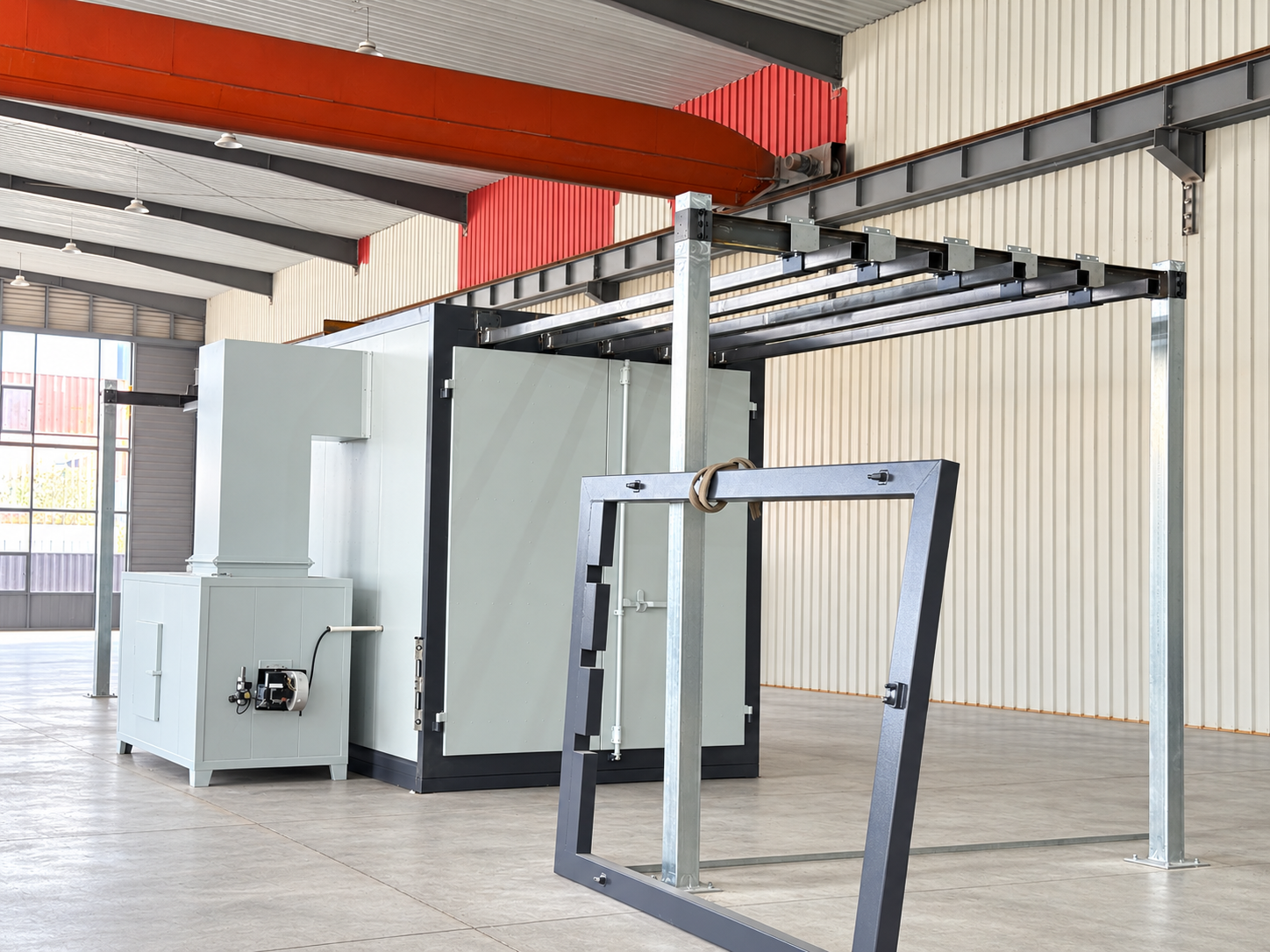
Parts can be suspended from an overhead rail arrangement and moved through the coating process. The oven, rail height, hanger spacing and transfer method are considered together.
A top-hung system needs to suit the size and weight of your components, the batch arrangement and the route between work areas. Movement may be batch or indexed according to the agreed design; an overhead rail does not by itself mean the system is an automatic continuous conveyor.
FROM LOADING TO UNLOADING
The oven is one part of the process. The way parts are loaded, sprayed, moved, cured and unloaded matters when planning the complete system.
Arrange prepared parts on hangers or a rack, allowing for their dimensions and the agreed working load.
Move parts to the preparation and coating stages in your workshop’s process. Booth and extraction arrangements are planned around the site.
Move the coated batch into the oven and run the specified curing cycle. Loading and movement depend on the agreed rail or trolley design.
Move cured parts to an appropriate cooling area, then unload and prepare the hangers or rack for the next batch.
Illustrative process only. This is not a site layout or a representation of automatic conveyor operation. Part preparation, movement method and curing requirements are agreed for the application.
SYSTEM DETAILS
| Hanging envelope | Largest component width, height and length in its hanging position, including clearance. |
|---|---|
| Working load | Component weights, hanger arrangement and required load capacity, confirmed for the design. |
| Rail & transfer layout | Rail height, spacing, supports and movement between process areas. |
| Production requirements | Parts per hour or day, typical batch size and the time available for each stage. |
| Oven & heating | Required chamber size, operating temperature and electric or gas configuration. |
| Controls | Digital control box or PLC touchscreen options according to specification. |
| Workshop footprint | Factory dimensions, available height, access and areas for loading and cooling. |
YOUR PRODUCTION BRIEF
These inputs establish the starting point for a written equipment specification. Rail capacity, transfer arrangements and production output need to be assessed for your actual parts and process.
Systems are supplied to the agreed equipment specification. Site preparation, electrical works, gas fitting, installation, certification, engineering approvals and local compliance are the purchaser’s responsibility unless specifically agreed otherwise. Use appropriately licensed contractors for site work.
Your quote sets out the equipment supplied, drawings and documentation, and the items your site contractors need to allow for.
YOUR NEXT STEP
Tell us what you coat, your required internal oven size and your location. We’ll help put together a suitable system.
REQUEST A QUOTE ↗